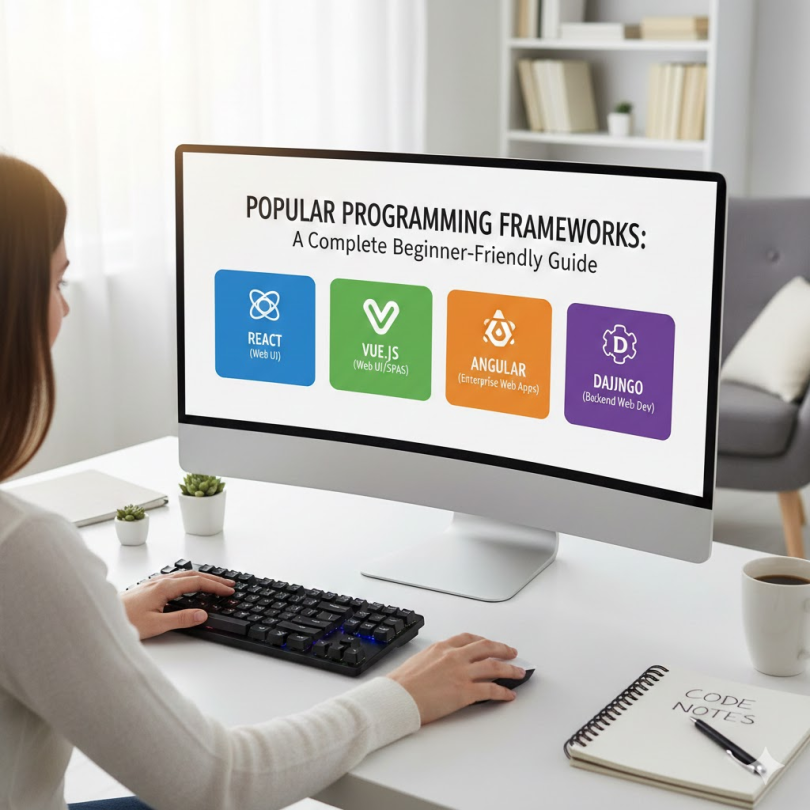

Introduction
In today’s digital world, software powers almost everything around us. From mobile apps and websites to banking systems and online education platforms, code is everywhere. However, writing software from scratch is time-consuming and complex. This is where popular programming frameworks play a major role. They help developers build applications faster, safer, and in a more organized way.
For beginners, frameworks may sound confusing at first. Many learners think frameworks are only for advanced developers. In reality, they are designed to make development easier, even for those who are just starting out. By using ready-made structures, tools, and best practices, frameworks reduce the need to solve the same problems again and again.
Over the years, popular programming frameworks have become the backbone of modern software development. Companies rely on them to deliver products quickly and maintain quality. Developers trust them because they follow tested standards and provide long-term stability. As a result, knowing how frameworks work is now an essential skill for anyone entering the programming field.
This article is written in simple English for beginners and intermediate learners. You will learn what popular programming frameworks are, why they are important, how to choose them, and how to use them step by step. We will also discuss benefits, risks, common mistakes, and expert tips to help you make better decisions. By the end, you will have a clear and practical understanding of popular programming frameworks and their real-world value.
What Is Popular Programming Frameworks?
Popular programming frameworks are pre-built collections of code, tools, and rules that help developers create software applications more efficiently. Instead of starting with a blank file, developers use a framework as a foundation. This foundation already includes common features like security, database handling, user interface structure, and error management.
A framework provides a standard way to build and organize code. It tells developers where to place files, how components should interact, and how requests should flow through the system. Because of this structure, applications become easier to understand, test, and maintain over time.
The word “popular” means these frameworks are widely used and trusted by the developer community. They are supported by strong documentation, active communities, and regular updates. Examples include frameworks for web development, mobile apps, desktop software, and backend systems.
In simple terms, popular programming frameworks act like a toolkit and a guide combined. They save time, reduce mistakes, and help developers follow proven development practices from day one.
Why Is Popular Programming Frameworks Important?
Popular programming frameworks are important because they solve real problems in software development. Without frameworks, developers would need to write the same basic code repeatedly. This leads to wasted time, higher costs, and more errors.
Frameworks improve productivity by offering ready-made solutions. Tasks like form handling, authentication, routing, and database connections are already built in. Developers can focus on application logic instead of technical setup.
Another key reason is consistency. When teams use the same framework, everyone follows the same structure and rules. This makes collaboration easier and reduces confusion. New developers can quickly understand existing projects.
Security is also a major factor. Popular programming frameworks follow industry best practices and receive regular security updates. This reduces the risk of common vulnerabilities and protects user data.
Finally, frameworks help applications scale. As projects grow, frameworks provide tools to manage performance, code organization, and future expansion. This makes them essential for both small projects and large enterprise systems.
Detailed Step-by-Step Guide
Step 1: Understand Your Project Needs

Before choosing any framework, clearly define your project goals. Ask yourself what type of application you want to build. Is it a website, a mobile app, or a backend service?
Consider factors like performance, security, user experience, and long-term maintenance. Some frameworks are better for small projects, while others are designed for large systems.
Understanding your needs helps you avoid choosing a framework that is too complex or too limited for your goals.
Step 2: Learn the Basics of the Programming Language
Frameworks are built on programming languages. Before using any framework, you should understand the basics of its language. This includes syntax, data types, loops, and functions.
For example, web frameworks often rely on JavaScript, Python, or PHP. Mobile frameworks may use Java, Kotlin, or Dart. A strong language foundation makes learning frameworks much easier.
Spend time practicing simple programs before moving to frameworks.
Step 3: Explore Popular Programming Frameworks
Research different popular programming frameworks related to your language and project type. Read documentation, tutorials, and beginner guides.
Look at community support and update frequency. A framework with active development and strong community support is usually a safer choice.
Avoid choosing a framework just because it is trending. Choose one that fits your learning level and project requirements.
Step 4: Set Up the Development Environment
Once you select a framework, set up your development environment. This usually includes installing the language runtime, package manager, and framework tools.
Follow official installation guides carefully. Proper setup prevents many common errors later.
After installation, create a sample project to confirm everything works correctly.
Step 5: Learn the Framework Structure
Every framework has a specific structure. Learn how files and folders are organized. Understand how requests move through the system and how components interact.
Study concepts like controllers, views, models, or components depending on the framework. These concepts help keep code organized and readable.
Understanding structure early saves time and confusion later.
Step 6: Build Small Features First
Start with simple features instead of building everything at once. Create basic pages, forms, or APIs.
Test each feature as you build it. This helps you understand how the framework works and how errors occur.
Small wins build confidence and improve learning speed.
Step 7: Use Built-In Tools and Libraries
Popular programming frameworks include built-in tools for testing, security, and performance. Learn how to use them instead of writing custom solutions.
Using built-in tools improves code quality and follows best practices. It also reduces maintenance effort.
Gradually explore advanced features as your skills grow.
Step 8: Test and Improve Your Application
Testing is an important step. Use the framework’s testing tools to check functionality and performance.
Fix bugs early and refactor code for better readability. Testing ensures your application works as expected under different conditions.
This step prepares you for real-world development challenges.
Benefits of Popular Programming Frameworks
- Faster development due to ready-made components
- Improved code organization and readability
- Strong security features and regular updates
- Easier teamwork and collaboration
- Large community support and documentation
- Better scalability for growing projects
- Reduced chances of common programming errors
Disadvantages / Risks
- Learning curve for beginners
- Overhead for very small projects
- Dependency on framework updates
- Limited flexibility in some cases
- Risk of outdated practices if not updated
- Performance issues if misused
Common Mistakes to Avoid
One common mistake is choosing a framework without understanding project needs. This leads to unnecessary complexity and frustration.
Another mistake is skipping language basics. Frameworks do not replace programming knowledge. Weak basics cause confusion and errors.
Many beginners copy code without understanding it. This slows learning and makes debugging difficult.
Ignoring documentation is also risky. Official guides explain best practices and updates.
Finally, not updating frameworks regularly can expose applications to security risks and compatibility issues.
FAQs
What are popular programming frameworks used for?
They are used to build software applications faster and more efficiently. Frameworks provide structure, tools, and best practices for development.
Are popular programming frameworks suitable for beginners?
Yes, many frameworks are beginner-friendly. They simplify complex tasks and provide clear guidelines for learning.
Do frameworks replace programming languages?
No, frameworks are built on programming languages. You still need to learn the language to use a framework effectively.
How do I choose the right framework?
Choose based on project type, language preference, community support, and your skill level.
Are frameworks required for all projects?
Not always. Small projects may not need frameworks. However, most professional projects benefit from them.
Can I switch frameworks later?
Yes, but switching can be time-consuming. It is better to choose carefully at the start.
Expert Tips & Bonus Points
Start with one framework and learn it well before exploring others. Depth matters more than quantity.
Follow best practices and coding standards recommended by the framework.
Practice by building real projects instead of only watching tutorials.
Join community forums to learn from real-world experiences.
Keep learning and updating your skills as frameworks evolve over time.
Conclusion
Popular programming frameworks have transformed the way software is built in the modern world. They provide a structured, reliable, and efficient approach to development that benefits both beginners and experienced developers. By reducing repetitive work and offering ready-made solutions, frameworks allow developers to focus on solving real problems.
For beginners, popular programming frameworks act as a learning guide. They introduce best practices, enforce clean code structure, and simplify complex concepts. With proper understanding, frameworks can boost confidence and accelerate growth in programming careers.
However, frameworks should be used wisely. Learning the basics of programming and understanding project needs are essential steps. When chosen and applied correctly, frameworks improve productivity, security, and long-term maintainability.
As technology continues to evolve, popular programming frameworks will remain a core part of software development. Investing time in learning them is a smart decision for anyone serious about programming. With patience, practice, and continuous learning, frameworks can become powerful tools that open doors to endless development opportunities.